
Mister Ed
On learning and unlearning

One can learn more about economics at the gym than in a high school economics class. Not, of course, that I would know—I didn’t have a high school economics class. We didn’t have phys-ed or sex-ed either. We had no ed. We called the standard curriculum “secular studies,” and the naming gives the gig away. To label a portion of the curriculum ‘secular’ in contrast with ‘sacred’ is to clearly subordinate it in the hierarchy.
In the black hat, “yeshivish” Orthodox high school I attended in the early 90s, we had an extraordinary culture of scholasticism, unexampled anywhere I’ve been since. It was not uncommon to see 14- and 15-year-olds bent over a Talmud for hours, vigorously cogitating and arguing about the book that earned the Jews the appellation People of the Book. Math, English, and science books, on the other hand, were another story altogether. Compliance with New York State’s Regents mandate was, as Marcellus told Hamlet, more honour’d in the breach than the observance.
My most salient high school secular studies memory is from English class, taught by Dr. Sellinger (not Salinger, though that would be an extraordinary movie plot: notorious hermit and celebrated author of the great American novel reappears in public life to teach writing to a bunch of illiterate yeshiva guys). Sellinger resembled a fin de siècle novel character: stringy, lank hair that looked like it lost a war with a comb, skin yellowed by chain-smoking. He had an accent to match, vaguely William F. Buckley-esque. A theatrical cadence amusing when trading arguments with James Baldwin and insults with Gore Vidal and just fucking hysterical when lecturing Pinchas Ze’ev about why writing English at a 5th-grade level might be a useful life skill.
One day, a kid who wasn’t intentionally misbehaving but was, like everyone else, completely uninterested in the subject, sat reading something under his desk and absentmindedly tossed a candy wrapper in the general direction of the trash. It hit the teacher. Sellinger bellowed: “Who threw that?” The kid, still half-engrossed, not even looking up, muttered: “It was me, it was me.” At which point the English teacher corrected him: “No, Mr. Schrieber—it was I.” And the kid said, “Yeah, yeah, it was you.”
That’s the only thing I remember from high school English.
A further note on the culture of study I came from, because I don’t want to leave a misimpression. The scholarship was extraordinary: genuine, rigorous, and consuming. I have encountered nothing like it since. I was an associate at a large law firm, and we worked soul-crushing hours (mostly for soulless ghouls), but there was zero pretense of scholarship. It was purely mercenary. Intellectual in the sense that duping out a full set of junior mezzanine loan documents at 2 a.m. requires a functioning brain, arguably a high-functioning one (jacked up on Starbucks Black Eyes), but there was nothing remotely elevated or scholastic about the endeavor.
The only time I’ve encountered anything in secular life that reminded me of yeshiva study culture was when Jonathan Franzen, doing press for The Corrections 25 years ago, mentioned that for months at a time he would read the works of the Western canon, twelve hours a day, to sharpen his own writing. I remember thinking: yes, that’s what being in yeshiva is like, only raised to the power of community and the pleasure of a study partner, and the entire apparatus of teenage status competition and sublimated male libido overfit on excellence “in learning.” Girls? Football? Garage rock band? Nah! Kidushin! (and in the abstract, only, to be clear). In fact, one cliché that has the virtue of being true: every year on Purim, the one day boys were truly encouraged to drink, in a culture that was (then!) quite abstemious, after getting properly blotto, every boy would stagger over to his rebbe and, in over-the-top maudlin fashion, confess through tears: Rebbe, I wanna learrrrrnnnn!!!!! A lachrymose view of Jewish history, indeed.
Except this culture of enormous scholarship is completely misbegotten, onanistic if I’m being ungenerous. It takes its best and brightest—and some of them are genuinely very best and very bright—and sends them to 19th-century rabbit warren neighborhoods in Jerusalem where they marshal their formidable minds to details of what animals to sacrifice on which day, in what number, with what pairing of grains and oils and incense. The minute, exacting particulars of a fantasy abattoir, one that hasn’t existed for two millennia. None of it has any practical application. It is meant to be operationalized only after a vague messiah, the details of whose arrival nobody can actually agree on (a donkey? an eagle? a vivified pile of bones from the Ohel of the Holy Sepulcher in Queens?), comes to redeem us and a Third Temple is built. This isn’t quite scholarship. It is a cargo cult. And one contemptuous of ‘secular knowledge’ whilst free-riding its extraordinary advances.
So I became an autodidact. When your education fails you, everything becomes a classroom. I found myself in a world I had not been prepared for and was forced to adapt, to accumulate knowledge datum by datum. Like an immigrant. Each encounter, each fact, was a discrete point. In isolation, barely anything at all. But eventually I stepped back and there was a Seurat.
I read the New York Times daily and looked up the definitions of words I didn’t know. This was in the embryonic days of the internet, when AOL discs magically appeared like manna and a whirring singsong announced a rare, and too slow, internet connection. So I used the actual gray lady and a hardback Webster’s. Quaint.
I learned how to order cocktails by standing behind friends and eavesdropping on their drink orders, then sidling up to the bar, nodding my head confidently at the bartender: “Kanqueray and tonic.” I’m pretty sure the ambient noise was loud enough that she didn’t catch it. But eventually I did.
I learned how few of the classic movies and music that were the shared hymnal and soundtrack of my friends’ lives I actually knew. I kludged my way to enough musical knowledge to avoid embarrassment. I learned, for example, that there actually is a Jay-Hova (and, he’s a hustler, baby). But I never cared enough to catch up cinematically and, to this day, when someone starts: “Do you remember the scene…” I immediately break in, “Nope.” Sometimes, “Fast Times at Ridgemont High? Sorry, I was in the yeshiva.”
I learned about Martin Buber’s I-Thou distinction the hard way. In my initial heedless rush to integrate into the outside world, I collected some friends who felt like the right people to be around rather than people I actually wanted to know. I-It relationships, dressed up as I-Thou. It took years to understand the difference. (How’s that for an elegant way to describe a walk of shame.)
I learned that hashish in the Sinai is not the same thing as standard issue US weed and, if you’ve not been to a high school or college where anyone does drugs, and you’re just trying to fit in with the kids you are doing a semester abroad with at Hebrew University, you may smoke too much and end up high as a kite meeting Saddam Hussein’s doppelgänger in a one stop sign (one camel?) Bedouin “town” who angrily shakes his fist at you because his relatives were killed in Desert Storm.
I had to unlearn some things too. I learned that intelligent design is nonsense from the Gila monster. After billions of humans have walked the face of the earth, it turns out there exists a compound that can alleviate an enormous amount of human suffering, the peptide that launched the entire GLP-1 revolution. It even exists in nature; the almighty, omnibenevolent divine artificer created it! It just happens to reside not in the human beings to whom it could be enormously beneficial, but in the venomous saliva of a slow-moving lizard in the Arizona desert. Very intelligent design.
I found I had no choice but to unlearn free will from LeBron James. Some of LeBron’s gifts are obvious and completely unearned: 6’7”, 270 chiseled pounds, can jump out of the gym, with the body control of a ballerina. Others are slightly less so. I long suspected that the greatest athletes possessed, in addition to their physical gifts, extraordinary court vision, superior visuospatial IQ. Then, after many years, I saw a clip of LeBron on JJ Redick’s podcast, where he described a coach telling the team to run a play he had previously drawn up for the opposite side of the court. For LeBron, flipping it in his head was effortless. He was dumbfounded most of his teammates couldn’t do it. There it was.
That wasn’t the lesson though. What one inevitably hears about the greats: yes, he had the physical gifts, but he also worked harder than everyone else. As if to explain the moral dimension of greatness, to reassure us it isn’t just a crapshoot: there is something “earned.” And that’s true. But then you ask: where did that work ethic come from? Is it some free-floating thing called “character” that doesn’t find its foundation or impetus in some combination of nature and nurture? It really cannot be any other than those two. And he, like all of us, didn’t choose either. So, in what sense do we have free will? I know this will distress the Orthodox world I grew up in, where the great Reb Aquinas insisted that we do, in fact, have free will. But alas, the equally great Reb I’m Taking My Talents to South Beach taught me otherwise.
I don’t know how many things I learned at the gym, but a lot of education crystallized there.
At some point I noticed myself optimizing workouts to maximize my WHOOP strain score. The measure had become the target. Classic Goodhart’s Law. The treadmill spiked my exertion number above genuinely grueling Aerodyne sessions, so I defaulted to the treadmill (the answer, fyi, is wearing a much more precise chest heart rate strap).
I embodied Baumol’s cost disease in my hip flexors. You tweak your left hip. Now you need to spend fifteen minutes before every workout stretching and mobilizing it. But you can’t just stretch one side, you’ll get imbalanced. So now you’re also stretching your perfectly healthy right hip. The cost of maintaining the healthy side has risen to match the cost of treating the injured one.
The first three months of lifting teach you about diminishing marginal returns. The novice adds weight to the bar every session; the advanced lifter celebrates a 5-pound PR after six months of grinding. The returns diminish.
But here’s the twist. While the physical returns diminish, the psychological returns demonstrate the eighth wonder of the world: compounding. Each workout isn’t just a workout; it’s a vote for the kind of person you are. And identity compounds, because it changes future behavior. The person who “is a gym person” doesn’t need to summon willpower to go. They just go. That’s who they are. Which makes the next workout more likely, which reinforces the identity, which makes the next one more likely still. The body plateaus. The self keeps compounding.
I learned about Zeno’s paradox on a treadmill. Or have at least spent time distracting myself in its brain-bending conundrum while blasting out a final mile, lactate building, breath catching. You’re halfway done. Then half of the remaining half. Then half of that. You will never finish. Except you do. You don’t solve the paradox. You run through it, like the tape at a finish line, in sweat and an elevated heart rate. Sometimes, in fact, your body knows things your mind can’t quite reason its way to; brawn over brains.
Then there were the things I learned that were yeshiva adjacent, or a fun house mirror reproduction of them. I learned of Leo Strauss from Tyler Cowen, the idea that serious writers communicate on two levels, one for casual readers and one for the initiated. And of course, Strauss grounded his entire theory of esoteric writing in Maimonides, who is the greatest expositor of the tradition from which I come, but whose more interesting ideas you learn almost nothing about in yeshiva. You learn the arcane. You learn the dry. You learn the clever Brisk orientation toward Maimonides and Talmud study, where formidable intellect is deployed to generate elaborate dialectics, breaking a concept into its constituent components (again, and again, and again; fractally, one might say, if one learned any math, which we did not), thinking through edge cases.
But you barely touch the Guide for the Perplexed. You learn nothing of his borrowing from Averroes (to think they forwent the chance to browbeat us about a “goyishe scholar whose very name sounds like aveiros!”) and Al-Farabi. Because more than anything, yeshivas are petrified that opening the aperture to any kind of outside thought, even when refracted through the Rambam himself, will cause massive attrition. And maybe they’re right. It turns out right-wing Orthodox Judaism’s true fitness function isn’t scholarship. It’s self-perpetuation. (Maybe I did learn something about evolution in yeshiva after all.)
Then you learn that Cowen, who is not himself religious but often extols the virtue of religion for society’s wellbeing and cohesion, has a dog named Spinoza. And you wonder: is that Straussian?
Of course in yeshiva we learned nothing of continental philosophy, certainly not German philosophy, for reasons that relate both to keeping the aperture sealed and to what German thought specifically would have represented to the grandchildren of Holocaust survivors (as I and 90% of my classmates were) in the early 1990s. But it turns out I did know something of Georg Wilhelm Friedrich Hegel, the greatest of the 19th-century German philosophers, without ever having heard his name. The Brisker method (hakirot, the splitting of a concept into its constituent parts, holding two (tzvei!) dinim in tension) is strikingly similar to Hegelian dialectics. I’d been doing it since I was fourteen.
And eventually, beyond his dialectics, I learned that Hegel famously said: one is either a Spinozist or not a philosopher at all.
So, I’ve realized, the most important thing I learned is that I am a philosopher, after all. And I always was.
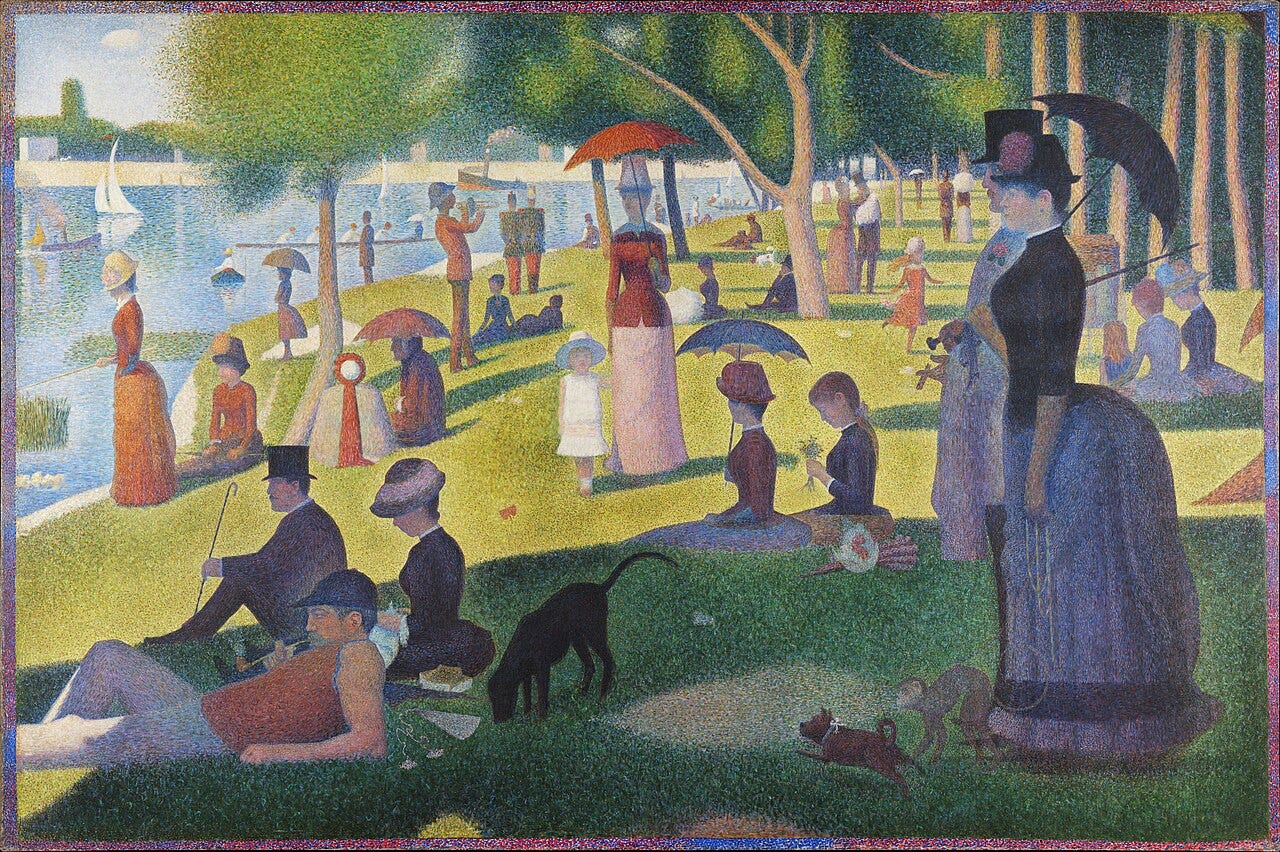
George Seurat A Sunday Afternoon on the Island of La Grande Jatte (Un dimanche après-midi à l'Île de la Grande Jatte) (1884-1886)
Your writing is clever but I find your arguments (i.e., intelligent design; free will) unconvincing.
What I am becoming more and more convinced of is my Theory that people who go off the derech for "intellectual reasons" come from yeshivish backgrounds, which are ripe for ridicule.