
On Naming Names
Scott on Scott

Scott Alexander has written a magisterial obituary of Scott Adams. The piece sits at the confluence of everything Alexander does exquisitely: analytical precision, lapidary prose, and, in this case, deep personal investment. Childhood admiration curdling into adult disillusionment, but with nuance, and grace retained. Professional expertise as a psychiatrist watching textbook patterns unfold in real time. When all these cylinders fire at once, you get something that exceeds even the typically excellent Astral Codex Ten post. You get this. Plus it’s funny.
I did not read cartoons growing up. (Well, I did, but they were called Artscroll biographies, fewer drawings, more fiction.) My first real collision with Scott Adams came listening to him on Sam Harris’s podcast, part of Adams’ victory lap after predicting Trump’s 2016 win. I didn’t know what to make of the guy. The entire time I listened, I wondered: is he in on the joke? It landed with the same credibility as the 12 daily voicemails I get from unrecognized numbers—I can’t know for sure that I am not pre-approved for a 70k loan, I guess. Over the years I saw clips of his podcast and the confusion only deepened. Alexander’s line about the uncanny valley of performed confidence made me laugh out loud:
“Oh hello, nice to meet you, I came here in my Ferrari, it’s definitely not a rental, you’re having the pasta—I’m choosing it for you because I’m so dominant—anyway, do you want to have sex when we get back? Oh, wait, I forgot to neg you, nice hair, is it fake?”
This captured exactly my reaction to the coffee-sipping shtick Adams started his broadcasts with. There can’t possibly be anybody taken in by this. And again: Is Scott in on the joke?
After Alexander’s obituary dropped, I saw several critiques about the “cheap aside” where Alexander named names, the passage where he listed public intellectuals whose brains had turned to “puddles of partisan-flavored mush”: Jordan Peterson, Ken White, Curtis Yarvin, Paul Krugman, Elon Musk, the Weinsteins. Alexander offered an able defense of his broadside, which he had clearly anticipated and reasoned through. It was the type of thoughtful, balanced answer one would expect of the legendary rationalist.
I take the opposite position from the critics, and a much less charitable one than the unfailingly good-faith Alexander does: I fully endorse what Alexander did. It was not only defensible, it was necessary.
What is the point of having fuck-you money if you never muster the courage to say fuck you when called for? What is the point of having fuck-you intellectual capital, as Alexander does, if you won’t call out broken-brained takes from people with outsized influence?
In fact, Alexander’s very obituary contains a vivid illustration of why I feel this way. I wasn’t familiar with Adams’ entire oeuvre. I knew the names of some of his books. But I had no idea, and learned in the obituary itself, that Adams wrote one called God’s Debris, in which, as Alexander points out, Adams independently recapitulated Lurianic Kabbalah.
I grew up in the right-wing Orthodox Jewish community. I know it from the inside, and I’ve watched it from the outside for the last 25 years. Kabbalah presents an interesting analytical case of the degradation of a culture’s shared epistemology in a fairly short period. One can hold to the side the deeply improbable notion that a specific book was authored by a divine creator and given to a very special group at a revelation on a small (humble!) mountain in a dusty backwater of the ancient world. One can even hold to the side the thesis that rabbinic Judaism is a natural extension of the dramatically different Temple Judaism it succeeded and that the Talmud was somehow also part of that divine revelation. These are foundational axioms of normative Orthodox Judaism. Neither is true, almost certainly, but one can understand that they are assumed as predicates and cannot easily be questioned (or even too closely inspected) by those inside the system.
But Kabbalah is another thing entirely. For many years, many great and well-regarded Jewish sages believed its ideas were nonsense. They understood that the Zohar was written a millennium after it was purported to have been written. They thought its ideas ranged from the merely fatuous to actively destructive. Kabbalah was, for centuries, viewed with suspicion by significant portions of the rabbinic mainstream, and treated as a restricted, esoteric pursuit.
And yet, in the course of just the last 25 years, I have watched the Orthodox community fall increasingly under its sway. Kabbalah is probably more prevalent and constituent of Orthodox Jewish life now than at any point since Sabbatai Zevi was pushing a fish in a baby carriage through 17th-century Salonika.
The examples are legion. Well-educated, thoughtful acquaintances flying to Israel for the pleasure of an audience with holy men kabbalists who seem suspended between psychotic break and epilepsy. Instagram kabbalah influencers who offer room-temperature bromides borrowed from half-understood ideas of this or that rebbe or mystic, while dressed like Miami club promoters. Crowds more enthusiastic about getting to Ukraine than even Putin, annually thronging the grave of a famous 18th-century rebbe/kabbalist for a version of bizarro all-male Rosh Hashana Burning Man. As if the world that shaped me decided to tie itself to the mast of the Daily News horoscope page.
Which brings us back to Scott Adams and his talking dog. Kabbalah has always obviously (to me) been nonsensical unfalsifiable acid trip fodder (10 sefirot? how about 100!) and mostly warmed-over, derivative Neoplatonism in the first place. It is also an obvious pseudepigraphic forgery: Moses de León wrote/redacted the Zohar (with, possibly, help from the angel Moroni), a millennium after the death of the purported author, Shimon bar Yochai.
And now I learned, from Alexander’s essay, it was also independently reinventable by a cartoonist between sketching upturned ties and talking dogs. If Scott Adams, a wildly ordinary man whose other spiritual contribution to humanity included the Dilberito, can stumble into the same cosmic insights as the Arizal, what does that tell you about the profundity on offer?
This is why naming names matters, why calling out bad epistemology matters. If you see something, say something. I have watched a community I know well drift into collective credulity, and I have seen the downstream consequences of this suspension of disbelief. The epistemological rot, the poor thinking, never stays sealed. It leaks into other areas. Always.
And so it is with our beloved country. It, and maybe the entire Western world, is in epistemic crisis, a full-blown episode. Leave aside the man at the center of it all, orange Voldemort, who inspires passions strong enough to distort any conversation. Just look, as one example of hundreds at hand, at the fact that a brain-addled vaccine conspiracy loon is now the head of HHS, rolling back vaccine recommendations. Why? Because the man who, to his eternal credit, fast-tracked Operation Warp Speed, knew that conspiracy nuts were a substantial part of his coalition and decided to sacrifice the thousands (millions?) who will suffer the perfectly predictable mortality consequences of skipped vaccines to get his short-fingered vulgarian hands on the levers of power again. We’re sitting on the sixth floor of the Texas School Book Depository playing Russian roulette with 6 bullets in the chamber and a barrel trained on our own temple, only this time the Kennedy is on the firing side of the weapon.
The causal mechanism(s) is hard to dissect out. Maybe it’s the ubiquity of social media, the unhorsing of news gatekeepers, audience capture, a balkanized information landscape, the long tail of the internet allowing every manner of derangement to find its tribe. Who knows. But, if you don’t see the issue, then like the old saw about not knowing who the mark at the poker table is...
This is the environment we’re in. People with reputations as intellectuals, to whom millions look up, should absolutely be called out when their epistemology visibly breaks down. It’s good that Scott did it.
To be frank, I’ve long been deeply suspicious of more than a few of the names on Alexander’s list. The Weinsteins have long trained their intelligence mostly at conspiracism and self-aggrandizement. Curtis Yarvin has always seemed to me like a thrift store Carl Schmitt with longer hair and a Jensen Huang hand-me-down leather jacket, as befits a Bay Area tech founder (an urbit-mensch).
It’s worth lingering a bit longer on the tragedy of Jordan Peterson. Because he is the most well-known of the group (and so, unsurprisingly, the only one who people I know cite approvingly) and someone who I’ve listened to tens of hours of (mostly in the series of public discussions he did with Sam Harris in 2018 in Europe).
If one’s working definition of intelligence is the ability to explain complicated things simply, what do you say about someone who does the opposite relentlessly? Whose every locution is a circumlocution. Who browbeats questioners for sensibly asking at the end of yet another 3-hour stemwinder about the unbeeeleeevable Jungian archetypes of Christianity what he actually believes—”Well, aye, it would take me 40 hours to answer whether I believe in the literal resurrection.” Sounds like the warning label on Viagra. And an obvious dodge. In a sense there is something tragic about Peterson. A brilliant man with a deeply fragile psyche who got swept up by superstardom’s jetstream and dissolved under the relentless spotlight, the crushing weight of being a guru to millions, having to play hide and go seek with his true faith (why, I’m unsure, but that he did it, I’m nearly 100% sure) into anti-woke spittle-flecked tirades made in sportcoats that would chagrin the most flamboyant popinjay whilst developing a nasty benzo addiction. That may read like an indictment or mockery. It isn’t.
Inaction is a choice too. As is silence. In epistemology, and in every domain of life. Saying nothing may be a good heuristic and may most often be the right choice, but it is not always the right choice. Eventually even studiously apolitical people, and refined, reticent ones, have to decide when to step into the breach. Every manner of “well you know they do have a grievance” and “turn the other cheek” and “I don’t want to offend people’s faith” is a perfectly practical and honorable position, until it’s not. In the limit, as a famous Frenchman said, “Those who can make you believe absurdities can make you commit atrocities.” Good on Scott for pulling the iron fist out of the velvet glove. Allez.
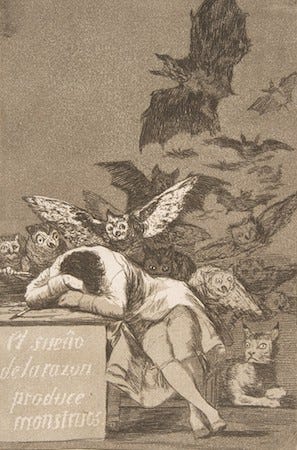
Francisco Goya Plate 43, The sleep of reason produces monsters from Los Caprichos (1799)