
OTD III
The Metamorphosis. -Kafka

I recall precisely when I went off the derech. Down to the location and month, if not the actual date. I was supine on a ratty futon on 91st Street between Lexington and Third Avenues. It was March of 2016. I was at the tail end of a period of meticulous observance. Of painstakingly heeding the rules, my faith steeled against occasionally burbling doubt. I clung ferociously to the hope of salvific possibilities. And then, gradually and then suddenly, my faith dissolved. All at once. It rose up off me like a spirit exorcised, gone without remainder. What flooded into the vacuum was curdled resentment, fury, for having been manipulated into the belief in the first place.
This was not a loss of faith in the author of the Five Books of Moses. No, that happened two decades earlier, and much less abruptly. This was a loss of faith in the author of the One Book of Moses (and Monotheism). When my marriage imploded in 2010, I went to see a therapist, as one does. Little did I know this pallid, doughy middle-aged shrink was a crypto-Freudian. After a few weeks of talk therapy, he suggested psychoanalysis. In my emotionally delicate mid-divorce state, I was an easy mark. Thus began 3-4 weekly psychoanalysis sessions. It lasted for six years. Six Sigmund, I call it, though with considerably less quality control that the corporate original implies.
I showed up like a dutiful analysand. Walk five blocks to the bus, ride across town, disembark, another five block walk. Over and over. Like a goddamn metronome. Get buzzed in. Barely a nod from Herr Doktor. Sit down on the couch, lifeless beige, take off my shoes (untie left, then right; I kid, these are Freudians not Pharisees) and lie down facing the opposite direction of the analyst.
I would do 90% of the speaking, session in, session out. This was not a function of my native volubility; this is orthodox Freudian practice. Transference or some bullshit. Occasionally the great man would weigh in with a glimmering insight: dream interpretation, “the garbage bags signify death,” “it means you want to have sex with her” (um, yes, that requires a Ph.D.?) or some other banality.
My misgivings started early on. It all seemed so unbounded, id and ego, oedipal complex, dream interpretation. All of it subjective and utterly unevidenced. I wasn’t a complete naif. I’d already divested of orthodox Judaism, having spent an ungodly amount of time scrutinizing its incredible tenets in the light of reason. I fancied myself an “empiricist” more than anything else. And here I was subjecting myself for hours a week to the untrammeled speculations of an acolyte ordained in the denomination of a pre-war Austrian Jew who came to his prophecies on the motive force of cigars and cocaine. All of it not just wrong, but patently unfalsifiable. I was, in some sense, a Popperian on a Freudian couch.
And yet, I swallowed my doubt, repeatedly. Of course I had noble motives, and elegant (and true!) rationalizations. “This seems rigorous.” “I don’t want a chatty yenta of a therapist that responds thoughtlessly to my every utterance.” I have excellent insurance, an easy work schedule, and only 50% custody of one child; I might never have the chance to do this again. “25 hours off electronics, a dopamine fast, isn’t our god a prescient genius” (I kid; these are Freudians, not Pharisees).
Ultimately though what kept me in line, what kept me paying for the privilege of hundreds of hours of balderdash, was the Kafkatrap. The clever, and devious trap, where one’s desire to leave is turned back on itself. It becomes part of the very problem the system one is trying to escape is needed to solve. You want to stop analysis? You demand proof that it is true? You want to know whether it works, that it leads to a well-lived life? What do you think these questions say about you? Why do you think you have this resistance? One’s obvious, and incontestably winning, questions don’t get or deserve an answer; they are further evidence of the questioner’s issues.[1]
But the Kafkatrap didn’t start on that couch. It is late 1998, or maybe early 1999. I am 22 years old, sitting across from a different middle-aged man in a modest apartment in Har Nof, itself appointed with a lifeless beige couch, fielding the following question posed in a rounded Chicagoan drawl: “Why don’t you wear a more sensible kippah, maybe a kippa s’rugah or a suede one?” The speaker is Jonathan Rosenblum, the charedi writer. I was wearing a maroon felt kippah, with wavy gold embroidered edging. “Because I am not modern orthodox,” I told him. “I am yeshivish essentially, I am an apikoiyres philosophically, the average of which might imply ‘modern orthodox’, but I am not. Plus, I want to wear a kippah that clearly communicates ‘I don’t tend to wear a kippah’.”
I had come to Israel to do a semester abroad at Hebrew University. I was only a couple of years removed from two years spent post high school in “beis midrash,” putatively learning full time but in fact just squandering both my time and my parents’ money. I had finally overcome my indefeasible people-pleasing to tell my parents “No mas,” like Roberto Duran. I left yeshiva and started matriculating at Queens College, still wearing a velvet yarmulka, casting about for an identity, for a way to fit in, to no great success.
My time in Israel was part Rumspringa (from which I never unsprung) and part exploration of Judaism, my faltering in it, my gathering faithlessness. To answer my questions and, more acutely, the questions that were asked of me: You demand proof that it is true? You want to know whether it works, that it leads to a well-lived life? What do you think these questions say about you? Why do you think you have this resistance?
Jonathan Rosenblum was my first stop. Here was a guy who had gone to Yale Law School (!!) and decided to become religious. He would certainly have profound insight into the veracity of the Torah and our tradition. I read his every Jerusalem Post column, printing out his full back catalogue and reading them on my flight to Israel.
He had, of course, nothing to say, because there is nothing to say. We all have a hole in our lives, I’ve come to realize. One might call it anomie or ennui or dukkha or any of the countless words that point to the core of what it means to be human, of the human condition itself. It must be just the headiest experience to grow up with a non-Orthodox Jewish identity, discover orthodox Judaism as an adult and have an epiphanous: THE SECRET TO LIFE, GOD’S VERY OWN SECRET, THE CURE TO MY EXISTENTIAL DILEMMAS, HAS BEEN HERE THE WHOLE TIME! AND IT’S MY VERY PATRIMONY! AND MY GRANDPARENTS THREW IT AWAY FOR THE CATCHPENNY SEDUCTIONS OF AMERICAN MATERIALISM! I say this completely unironically. It must be fucking sublime. But I was born into the thing. I saw them put the rabbit in the hat. And no matter how smart you are, or how many future Supreme Court justices you took constitutional law with at YLS, or how charming it sounds when you say “tour’ah oo’me’sour’ah” in a haven’t-quite-mastered-Hebrew/Yeshivah-elocution sort of way, you won’t convince me to join in your slack-jawed wonder at the sacred magic of it all. Tricks are for kids.
I also went to see Rabbi Yitzchak Breitowitz (Harvard Law School!). I recall almost nothing of that visitation. I don’t recall what yeshiva he was lecturing at then, or whether he was wearing the same rumpled fedora I see him in the videos YouTube occasionally serves me (my pinteleh algorithm) as he declaims broadly across Jewish law and theology in his adorably nasal singsong. He was kind, and learned, and had nothing to offer me either.
What I do remember of our meeting is that I self-deprecatingly referred to my going to visit him as part of the “save the Arele tour,” riffing off save the whales. I had, I realize in retrospect, internalized the idea that I was somehow broken. That my unremitting questions about the unbelievable faith I was raised in, that I was choking on, were my issue. I needed saving.
Psychoanalysis’s armamentarium of coercion is laughably thin compared to that of right-wing orthodox Judaism. Psychoanalysis lacks childhood indoctrination, communal reinforcement, or an endless series of behavior-reinforcing practices (these are Freudians, not Pharisees). It has no deity, no frightful supernatural consequences designed to haunt small children into fearful compliance. It doesn’t deprive one of the education required to succeed once one leaves the couch. It hasn’t Holocaust guilt, nor claims to millennia of tradition your doubt threatens to shatter. It never says, “well, we’d love to have you come for Shabbos, even if you can’t stay for the whole thing, but what kind of example would that set for the other kids” (or, in the literary French: pour encourager les autres).
And yet, the Kafkatrap works in psychoanalysis even without the layered apparatus right-wing orthodoxy uses to rigidly police its borders. I could not possibly know how many people stay stuck in psychoanalysis far longer than they might, because of insidious questions that bend back on the asker, like an ouroboros — “Why do you want to leave? What do your questions say about you?” — but I’d lay good money on “a lot.” Why do I want to leave? Because any system that has no substantive answers to manifold and obvious questions of its truth claims, that has to weaponize questions to deflect from its lack of answers, is not a system worth staying in. What do my questions say about me? Nothing. Like a cigar, sometimes a question is just a question.
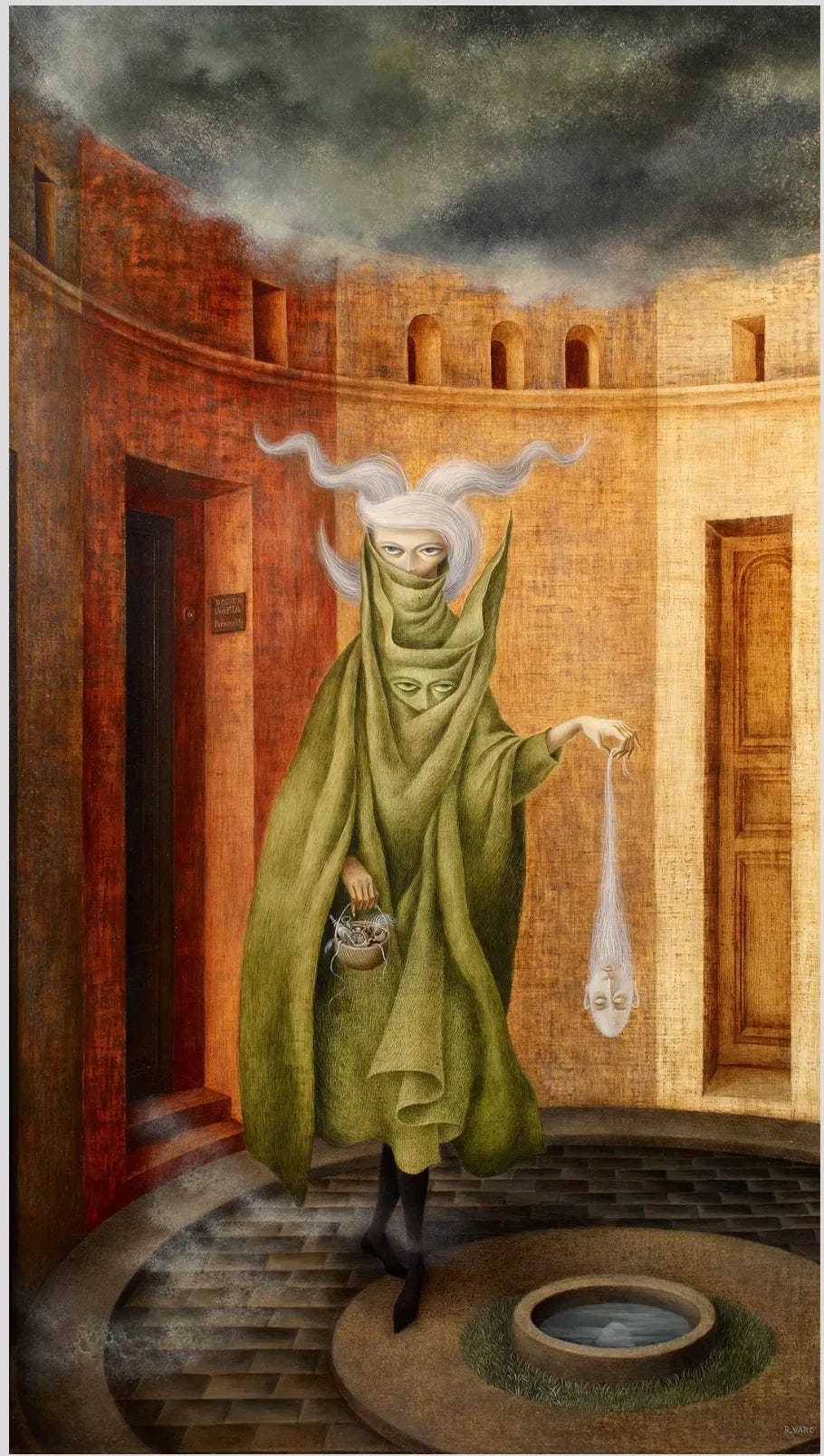
Remedios Varo Woman Leaving the Psychoanalyst (1960)
[1] I finally mustered the nerve to leave when years of growing unease intersected with showing my analyst a younger picture of myself with friends, all of us in fedoras. He made a comment about hat or brim size being a phallic competition. “What a moron,” I thought. Absolute hammer-nail situation. I wonder what he’d say in 2026 with brim sizes having dramatically shrunk. It was also around that time I encountered a quip by Karl Kraus, a contemporary and antagonist of Freud: “Psychoanalysis is that mental illness which claims to be its own cure.”
Super intriguing read.
I think there’s a paradox here
Because I for one do think it says something about someone that they ask a question, or which questions they ask but not necessarily a bad thing. In fact most people who ask lots of questions instead of swallowing things are thoughtful people who want something more then just following the crowd.
So on the one hand a question is just a question on the other if you’ll listen to different people’s questions you’ll likely gain a glimpse of who they are.
The problem is they tell you you’re *broken* or *wrong* for asking questions. Oh, you have this question and no one else well you gotta be wrong. That’s the trouble. They glorify the one who doesn’t ask questions and continues the status who as if that’s the “normal” thing to do.
Very well written and good comparison. I've had similar experiences with psychoanalysis.