
Two Gifts
An Iron Law

There is a tradition in certain precincts of the Orthodox community of a son giving an annual lecture to commemorate a parent’s yahrtzeit. There is an unignorable doubly performative aspect at play—”my father was meritorious enough for the posthumous honor, and I am great enough to offer it”—a preening version of the humblebrag, you might say, the bragbrag. And yet there is something nice about the gesture. The lectures are usually about Torah, about the departed’s character, about legacy. This is not that.
I wrote a requiem for my mother on her first yahrtzeit. Today is exactly two and a half years since she joined the great choir invisible. I still think about her almost daily. My mother gave me two great gifts in life. She gave me many others, of course—life itself, six siblings I love fiercely, the kernel of a sense of humor (as I never tired of telling her, “I have your sense of humor, only much better”), warmth, support, the instinct to read a room. But she gave me two gifts inadvertently, both born of anguish and suffering, and I know she had complicated feelings about each.
The first was free thinking. Her body failed her at thirty-five; a tumor colonized her viscera and put paid to her mobility for the remaining thirty years of her life. Watching her suffer made it very difficult for me, viscerally, to accept the God she believed in. Her physical undoing occasioned my theological one. Sometimes I think I disbelieved so that she didn't have to. I asked the obvious questions of theodicy so that she could cling tightly to God, with the same ferocious grip she white-knuckled her canes, and flung her uncooperative legs forward in the impressive, and ghastly, simulacrum of walking she managed for a few years after her surgeries. She quickly lost even that modicum of upright dignity to a full-time wheelchair at 40.
The second was working out.
I’ve always suspected that my obsession with the gym, which I took to just a few years after she was incapacitated, was somehow a response to her infirmities. Her inability to walk made me want to run. The weakness I saw in her recalcitrant legs midwifed a mania in me to be strong. I don’t think I understood this consciously at the time. I’m not even sure I’m right about it now: Man works in mysterious ways. But the correlation is too stark to ignore: my mother was a cripple and I worship, deliberately, religiously, in the temple of iron and vitality. Her physical suffering was imposed; mine is chosen. Again and again.
She didn’t care much about fitness one way or the other. Other than the occasional mischievously arch “such skinny legs” as she grabbed my quadriceps—especially easy from her perpetually seated position—it wasn’t her world. But she made it mine.
I once heard a devoted meditator say that even if meditation damaged his body, he would still practice it. The insights, understanding one’s own mind, seeing through illusion, waking up, are so valuable he would accept physical costs to keep them. The health benefits are just a bonus.
I feel the same way about the gym.
The pleasure of working out, of transmogrifying pain into pleasure and discipline into a literally changed body, the conversation between will and resistance that, in the best case, resolves in the body crumpled, unstrung, quavering on the floor gasping for breath, for life—is so transcendent that I would do it even if it didn’t have peerless physical and health benefits. I go the gym to kick the shit out of myself. To break my own will and then have it break me back.
The purity of the pursuit seduces me. There is nothing subjective about working out. Neither the imprimatur nor disapprobation of the powerful, or the powerless, affects results. It is impervious to political maneuvering, nepotism, or any of the other crooked ways of man. The output will equal, precisely, the input. The feedback loop is as tight as it is elegant. No higher power will intercede to save you. As gym-bro-Thucydides said, ‘The strong are what they do and the meek suffer what they don’t.”
After thirty years of working out, I finally bought a weight belt for squatting and deadlifting. There are always things to improve and fears to overcome. When I finally get my tenth clean back squat rep at 225, I will re-rack the barbell, point heavenwards and say, “How about these skinny legs, Ma.”
Rest in peace, Toby Friedman. I hope your spirit runs free and fast, now.
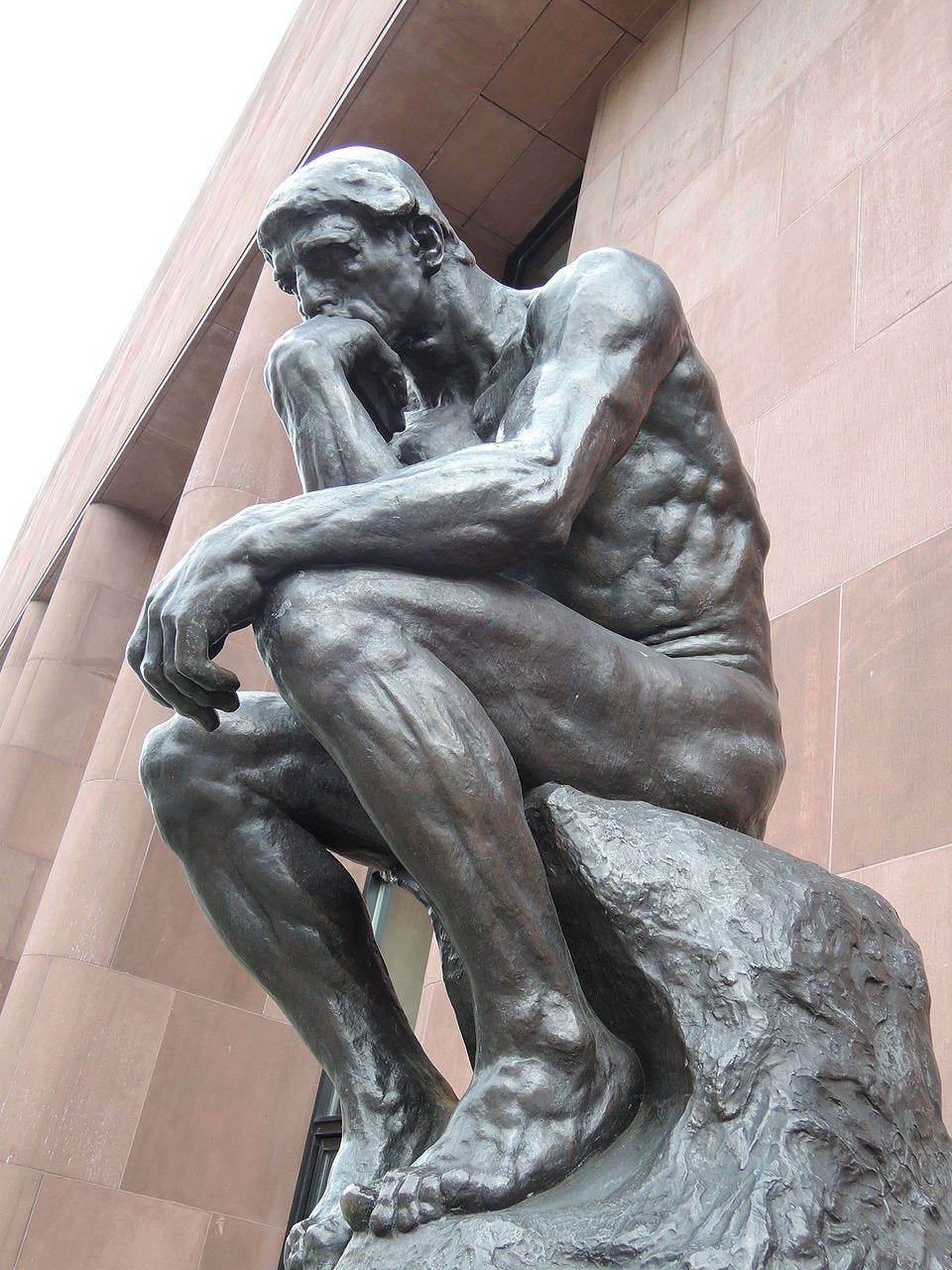
Auguste Rodin - The Thinker (Le Penseur) (1904)