
Dolce Et Decorum Est
Notes From the Garden

I found myself scrolling Instagram the late October evening of the Omer Adam concert at Madison Square Garden. Where Willis limped the Knicks to glory and Elvis crooned, Jews of all stripes sang, danced, and swayed to the musical stylings of Israel’s biggest pop star. The concert coincided with the Gaza ceasefire and release of the living Israeli hostages and began with a gorgeous video montage of the hostages reuniting with their families (enough to make a grown man cry; asking for a friend). The news turned the concert into a celebration of the end of a two-year communal nightmare, a dark dream that began with the vertiginous shock of October 7, 2023 and settled into the daily, slowly dawning recognition that the goldeneh bubble of American Jewish exceptionalism was cracking under the worldwide anathema directed at Israel’s harrowing, crushing war on Gaza.
“It’s over! We survived! Things will get better now!” one sensed in the overlays of Am Yisrael Chai that unfurled across dozens of reels on my phone. “Stronger together,” “best night ever,” superscripted snippets of blue-and-white-clad throngs in the arena, and ecstatic clusters in the plaza outside, singing slow elegiac songs and aggressive, triumphal ones. Relief, hope, and unbridled joy, exponentiated by the tribal power of 15,000 people.
What struck me most were the posts rhapsodizing about Adam’s performance of Vehi She’amda, a popular religious song set to a well-known passage from the Passover Haggadah. The lyrics are rendered in English as follows:
And it is this that has stood for our ancestors and for us.
For not only one enemy has risen up against us to destroy us,
but in every generation they rise up against us to destroy us,
and the Holy One, blessed be He, saves us from their hand.
It is a poignant, if maudlin and epistemically squishy, song (one I rather like). Its message of the indefeasible resilience of the Jewish people, engineered by God himself, resonated with the moment. Legions of posts described how moving it was to sing it with thousands of other Jews.
I was many miles from NYC that night. I watched the show in fragments on IG, from a geographic remove. And I watched from a temporal remove: thirty-five years. April 26, 1990, to be exact. I was 13 years old, in the eighth grade. Freshly bar mitzvah’d. Recently minted gemara ba’al peh champion of my class. Possessed of the uncomplicated right-wing Orthodox Jewish belief system I had inherited.
The 9th global Siyum Ha’shas was held that April night at MSG, a celebration of the completion of the Talmud by those who study a folio a day, a 7.5 year endeavor. It is the Western States 100 of textual study. The siyum was a big deal in the tiny world I grew up in, a testament to the soaring confidence of the “yeshivish” Orthodox within the American Jewish community. The 1990 siyum was slated to be four times larger than the previous cycle’s gathering in 1982.
My most unshakable memory of the 1990 event was the mass Shema Yisroel said at the evening Maariv service. Our rebbeim had wound us up for weeks about the transcendence of saying the Shema Yisrael with 20,000 other frum yidden. The prayer, which first appears in Deuteronomy 6:4 as part of Moses’s final address to the Israelites before they enter the Land of Israel, is often described as the central declaration in Judaism. It is said twice daily as part of the prayer service, again each night before going to sleep, and by Jews before they die. It is like a catechism crossed with last rites and the shahadah, all rolled into one. I remember covering my eyes with my hand and mouthing the words with slow intensity, feeling the cacophonous roar of 20,000 syncopated “Shema. Yisroel. Adonai. Eloheinu. Adonai. Echaaaadddd” wash over me. Each word a sentence. Each sentence a petition. A lineage. A declaration of eternity.
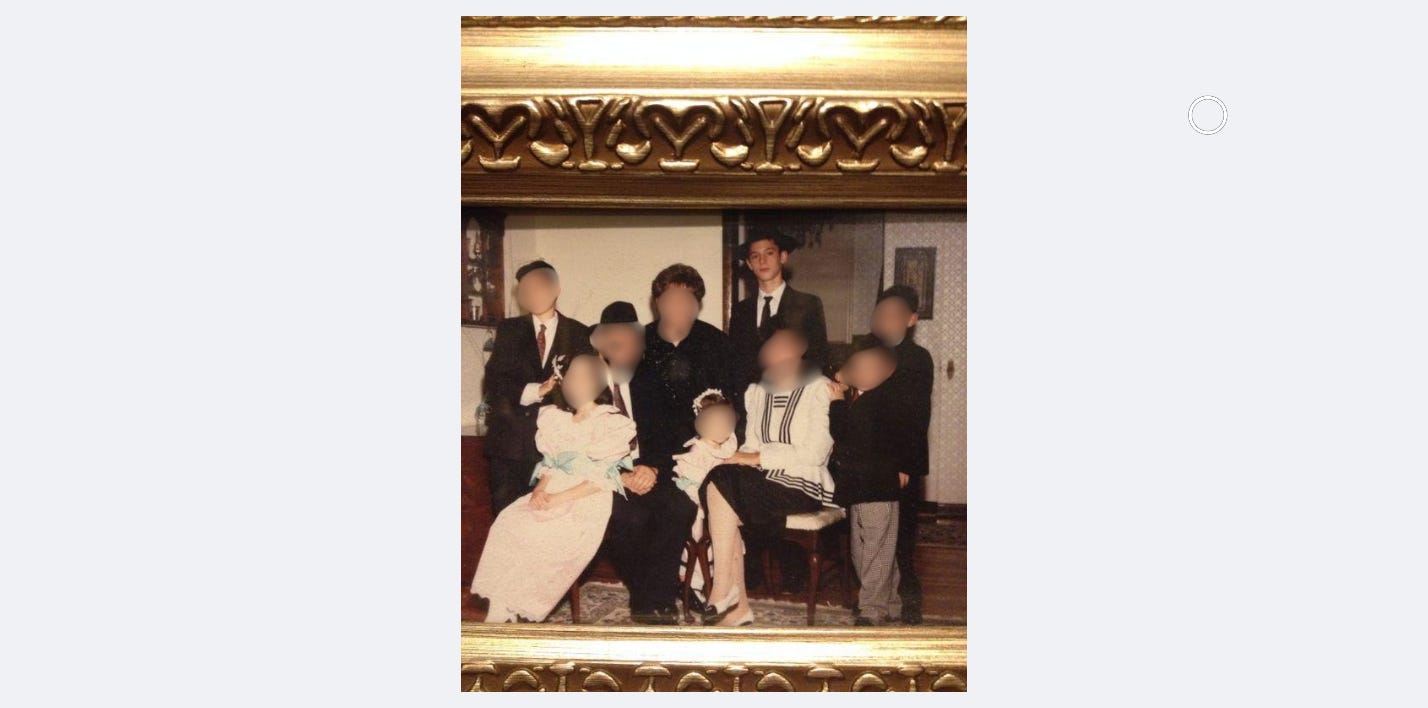
That 13 year old boy in the black Stetson fedora (oh how I’d begged for a Borsalino) would eventually find it impossible to be aroused by the frisson of religious practice performed in large crowds. He would come to realize that the numinousness it occasioned, its brief affordance of slipping the surly bonds of earth, was predicated on a cluster of beliefs that almost certainly aren’t true. It was a trade not worth making.
Eventually I grew skeptical of the very emotions engendered by the tribal intensity. Its catchpenny appeal has a dangerous side; too often its “we’re all in this together” is twinned with “and they are not.” Not always, but often. And if not in any given event, then in the theology that is the seedbed in which these events are nurtured.
So as the delirious Vehi She’amda posts from contemporary MSG popped up on Instagram, I knew I had seen this movie before. It wasn’t merely the perfervid crowds singing religious anthems with the same unironic intensity I had as a pubescent 13-year-old in 1990 that disquieted me. The singing was epiphenomenal, a surface effect of the ways the searing trauma of October 7 has calcified into a strident tribalism and a corrupted epistemology. There are catechisms about Israel that one must intone, and heresies one must never utter. There are articles of faith, too, promulgated and enforced on social media by bikini Ben-Gvirists or shouty hasbarapreneurs who might - but I’d bet not - read Hebrew above a second grade level, or are shomer Shabbos only when he’s on Piers Morgan. Not exactly Maimonides, but “niskatnu hadoiyrois,” as we’d say in yeshiva. The entire project has been fully sacralized, its tenets hardened into dogma.
The concert crowd, spanning nearly the entire Jewish bell curve (progressives and the ultra-Orthodox excepted), sang with a “secular” Israeli pop star flanked by thrusting, catsuited dancers to an old Passover chestnut lifted straight from the Haggadah, and written and performed by two prominent Orthodox “Hasidic music” stars (one Israeli, one American; one Sephardic, one Ashkenaz)1. It evinced a fully realized syncretism of Judaism and Israeli-ness.
No matter one’s views on the Israel–Gaza war, the extreme disregard for the humanity of the “other” and, more depressing still, the fire hose of distortions, obvious untruths, and “don’t believe your lying eyes” narratives that have become communal verities —repeated with drumbeat regularity, enforced as new cherem litmus tests, and clung to as a flimsy lifeboat for maintaining a Manichean, absolute good-versus-evil cartoon— are fucking devastating. Some of the things I have read in text groups and heard with my own ears from people I know to be wonderful, kind human beings are shameful and unspeakable (and better left unspoken). Certainement, qui est en droit de vous rendre absurde est en droit de vous rendre injuste. In the process, some of my cherished beliefs have been disassembled; others remain but are unmoored.
If that feels too sententious, fine. Consider pragmatics instead. The insistence that Israel is 100% right about everything and, by consequence, that any strong opposition must be explained by antisemitism is misbegotten. The slide from “Is anti-Zionism antisemitism?” to “Anti-Zionism is antisemitism!” to, tacitly, “Only anti-Zionism is antisemitism,” has been as imprudent as it is imprecise. It has permitted, and increasingly compelled, a lockstep alliance with the Republican Party, precisely as that party welcomed back all of William F. Buckley’s castaways. In the process, the longstanding bipartisan posture that served the institutional American Jewish political community for decades has been blown up, largely in a fit of splenetic outrage at left-wing college kids protesting Israel’s destruction of Gaza. Whatever you think normatively, C’est pire qu’un crime, c’est une faute. It will end in tears. It has already started. The calls are coming from inside the house. It was visible ex ante to anyone not in thrall to the “Israel right or wrong—and only” version of the American Jewish project. The pity of it all.2
Before the seven-minute terminus of Instagram scrolling, the social-media half-life by which point one’s brain begins to decay, I found myself rewatching the concert’s opening montage. I noticed, for the first time, that it began with an Israeli military mashup: helicopters roaring, a chanukiah (“menoiyruh!”) being lit in the rubble of Gaza, infantry marching, all set to vaulting music. It brought to mind one of my favorite poems.
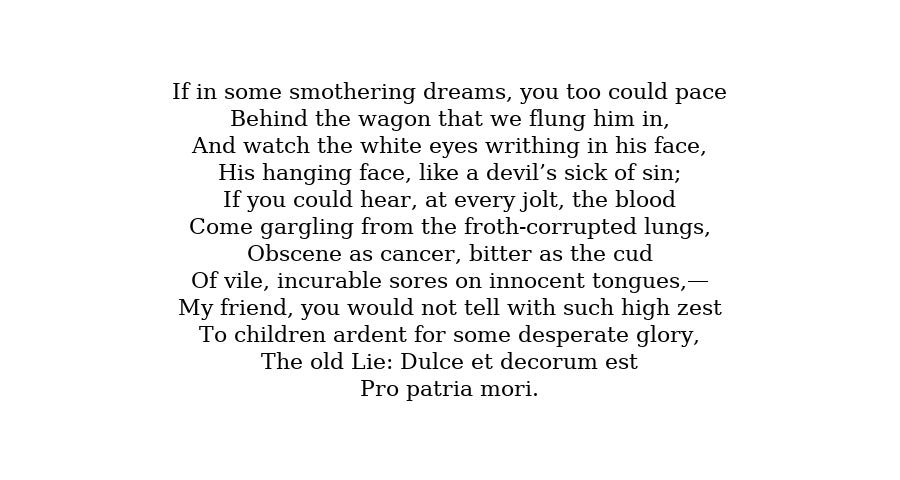
It may be an artifact of the time in my life I first heard it recited, or the person who recited it, but Wilfred Owen’s “Dulce et Decorum Est” has always moved me. It captures in haunting lines how the hortatory, noble injunctions of sacrifice for nation, faith, and filial piety collide with the reality of war and end up guttering, choking, drowning.
The entire poem rewards reading, many times over, in fact. I will share the last stanza, which was still reverberating in my mind as I flicked my thumb up, closed out of IG, and said goodbye to all that.
Am Yisrael Chai: “The people of Israel live.” A modern Jewish slogan and song expressing collective survival and resilience.
Vehi She’amda: A passage from the Passover Haggadah describing how, in every generation, enemies rise against the Jewish people and how God saves them.
Haggadah: The liturgical text read at the Passover Seder, recounting the Exodus from Egypt.
Bar mitzvah’d: Having undergone the Jewish coming-of-age ritual (typically at age 13 for boys), signifying religious adulthood.
Gemara: The core analytical component of the Talmud, consisting of rabbinic debate and interpretation of Jewish law.
Ba’al peh: “By heart”; refers to memorizing and reciting texts without looking, especially Talmudic passages.
Siyum HaShas: A celebration marking completion of the entire Talmud by those who study one folio per day over a 7.5-year cycle.
Yeshivish: Refers to the culture and worldview of Lithuanian/Haredi Orthodox Jews centered on yeshiva learning and traditional norms.
Maariv: The Jewish evening prayer service.
Shema Yisroel / Shema Yisrael: Judaism’s central declaration of God’s oneness; recited twice daily, before sleep, and traditionally at life’s end.
Frum: Yiddish for “religiously observant.”
Yidden: Yiddish plural for “Jews.”
Rebbeim: Plural of “rebbi”; teachers or rabbinic instructors in a yeshiva.
Niskatnu hadoyrois: Aramaic/Yiddish expression meaning “the generations have diminished,” lamenting perceived spiritual or intellectual decline.
Chanukiah: A Hanukkah menorah with nine branches, used during the Festival of Lights.
Hassidic music: A genre of Orthodox Jewish spiritual/pop music associated with Hasidic communities, often heard at weddings and religious events.
Cherem: A form of communal sanction or excommunication; historically used to enforce norms or punish heresy.
Ashkenaz: Jews of Central and Eastern European descent.
Sephardic: Jews of Iberian, Middle Eastern, or North African descent.
Ben Gvirist: In the mold of Itamar Ben Gvir.
“Certainement, qui est en droit de vous rendre absurde est en droit de vous rendre injuste.”: The original French phrasing often attributed to Voltaire, expressing the idea made famous in its paraphrased form: “He that can make you believe absurdities can make you commit atrocities.”
“C’est pire qu’un crime, c’est une faute.”: French for “It is worse than a crime; it is a blunder.” A well known aphorism (mis)attributed to Talleyrand.
“Dulce et decorum est pro patria mori.”: Latin for “It is sweet and fitting to die for one’s country.” From Horace, Odes (Carmina) III.2.13.
Black Stetson Fedora: A picture is worth a thousand words.
The song was originally composed by the Jerusalem-based Orthodox musician Yonatan Razel and popularized globally by the American Hasidic pop star Yaakov Shwekey.
A nod to Amos Elon’s The Pity of It All (2002), his history of German Jewish cultural achievement from 1743–1933.
We as a people are no less entitled to patriotism, love of our ancient homeland, love of our ancient and apparently indestructible faith and all the good that both have engendered.
Yes, we are not perfect and there is the ever present danger of extremism that must be carefully watched.But the above described spirit protected us from the Nazified mind set of Hamas who perpetrated the greatest mass murder of our people since the Holocaust.
"Possessed of the uncomplicated right-wing Orthodox Jewish belief system I had inherited."
That's disingenuous. Bergenfield, Passaic, 5 Towns, Lakewood, Monsey, Kiryas Joel. Cleveland, Chicago, Baltimore. All these very different cities have large right wing OJ communities, and are filled with schools and shuls representing diverse viewpoints. If they're uncomplicated, then everyone is uncomplicated.
You choose to look at selected text messages and see a parade of horribles. When I look at the OJ community, I see a vibrant, energetic community, with young, old, and middle aged. I see a community that strives to be better, that honors its scholars, that promotes entrepreneurship, that looks after its weakest members. I see a community with diverse opinions and backgrounds, but centered around bedrock principles that holds them together.
In short, with all its warts, prejudices, and questionable premises - and anyone intimately familiar with any community is aware of such things - the orthodox community has a heck of a lot be proud of. I'm all in.